So I'm not gonna pretend that I picked up this book for any other reason than nostalgia after watching the new movie version of The Great Gatsby. And it seemed like an interesting perspective - getting F. Scott Fitzgeralds' wife's story, especially considering how Fitzgerald has been accused of being a misogynist. This is Zelda's story - as a novel - but it is the story of Zelda's life with F. Scott, or Deo as she calls him.
We follow Zelda from when she first meets Scott in 1918. Zelda is 18, beautiful, admired and impulsive. She loves to flirt and her evenings are preoccupied with entertaining soldiers waiting to be shipped off into the war. Among them is Scott, the aspiring author, the man who stands out and speaks to something deep inside Zelda. Although her parents oppose the match, Scott will win her, and soon they start their new married life in New York.
Zelda and Scott make up the perfect couple for the era. Glamorous and scandalous, Zelda quickly learns that she must publicly play a part to fit in with Scott's fiction of who they are. There's always a party, always booze, always an excuse to spend money. And as Scott's literary success increases, it seems that their lives are escalating more and more out of control.
In their quest for stability the couple travel from place to place, finally settling for a longer time in Paris. While Scott should be working on his new novel, he prefers pursuing his new bromance, Ernest Hemingway, a then aspiring author Zelda distrusts from day one. The more Zelda speaks up against Hemingway, the more Scott's esteem for her drops. Throughout their strife, Zelda keeps trying to find her own path. She wants to be more than wife and mother. She can write, she can paint, she can dance ballet, but Scott wants to keep these preoccupations in check.
The conflict between the couple becomes so strained that Zelda throws herself into an extreme ballet dancing routine. Ballet becomes her sole sense of achievement in life, as Scott seemingly cares less and less about her and her opinions. In her pursuit for perfection, however, Zelda throws herself head first into a mental breakdown.
Although this is a novel and not a biography, I feel that Fowler has succeeded extremely well in retaining a sense of truth. Zelda and Scott's relationship is complex and forever changing. There are infidelities, alcoholism and resentment, but also encouragement, compassion and loyalty, and a sense of belonging. Throughout the hardships they face, the love and the well wishes seem to survive. What is also beautiful is the humour between the two. And even though one might come away with the impression that Scott wronged Zelda, Zelda refuses to cast him off completely, and still sees a future for the two of them: "If I could fit myself into this mail slot, here, I'd follow my letter all the way to Hollywood, all the way to Scott, right up to the door of our next future. We have always had a next one, after all..." (p. 1-2, my italics).
I like the Zelda of this novel a lot. She might start out as a flapper, a glamorous party girl without a care in the world, but she grows to being an independent woman who thinks for herself and who is ready to fight for what she believes in. Z is both delightful and sad, and in the process of reading it, I find myself wanting to learn more about this woman and curse myself for not being more interested when I did American literary studies. What a woman, Zelda Fitzgerald! I am charmed and inspired.
Friday, 21 June 2013
Wednesday, 19 June 2013
Night Film by Marisha Pessl | Enter Darkness
So I wasn't a hundred percent sure I wanted to read this, because I read Special Topics in Calamity Physics and wasn't as awed as everyone else. Luckily I was in the mood for something horror-like. Winter has hit Joburg and all I want to do is snuggle under a blanket with a good scary book and a nice cup of tea (or a deliciously dark glass of red wine!). So after reading the blurb for Night Film I decided to give it a shot. It turned out to be just what the doctor ordered.
From the very first pages I knew that this book was going to be different. Newspaper clippings, photographs and online searches are part of the story, and I find this element to be one which resonates with the time we live in. Instead of constantly being told what's happening, we can make up our own minds, based on the information supplied from these "external" sources.
We follow investigating journalist Seth McGraw in his attempt to redeem himself to the public eye through unmasking his "enemy", cult horror director Stanislav Cordova. Cordova's character is immersed in mystery, as he hasn't been seen in public since the 70s. All his movies are shot on his private estate, and he sternly refuses to do interviews. All dealings with the public go through his seemingly bland assistant Inez Gallo. And strangely, actors that have worked with Cordova refuses to talk about their experience working with him, or worse, turn up missing or die under strange circumstances. When Cordova's 24-year old daughter Ashley is found dead after what looks like a suicide, Seth decides it is time he looked into Cordova again. Along the way he picks up some unlikely sidekicks. Nora the aspiring actress and the less stable Hopper who deals drugs when he's not dedicated to the cause.
Through tracing Ashley's final movements, Seth and his helpers manage to slowly hone in on Cordova's well-guarded universe. The closer he gets, the more Seth has to realise that not everything has a logical explanation. The occult seems to be hiding behind all the doors they open, as their search takes them through mental institutions, secret internet sites, "forgotten" clubs reminiscent of the secret club in Stanley Kubrick's Eyes Wide Shut, magical shops and finally Cordova's estate. The truth about Ashley the pianist prodigy is turning out to be a lot more complex - or perhaps a lot simpler - than Seth could ever have imagined.
Throughout the reading of this novel I had the same uncanny feeling I get when watching a David Lynch-movie. There are all these characters that seem to appear out of the blue, but you never quite know if you can trust them, or why they are there. Lynch also uses magical and occult elements in his movies and series. How awesome would it have been to see what kind of movie would come out of this in Lynch's hands?! (The book is being adapted into a movie - I'm really excited about that, but not by Lynch, sadly.)
I haven't read a book like this before, and I can only compare it to Chuck Palahniuk's Haunted in messed-up-ed-ness. Night Film keeps the suspension tense until the end, never quite letting us go. We learn that Cordova, in his movies, always have an open ending. His viewers are not given clear answers, they must themselves decide what to take from it. Pessl similarly also leaves us with an open ending in which we can draw our own conclusion. Do we believe in the existence of mermaids, or are they mere myth?
Night Film is an extremely successful thriller/horror/transgressional novel. I climbed right into Pessl's, and Cordova's world of smoke and black mirrors, and I got completely lost in Seth's dark odyssey. I don't care if it takes Pessl another 7 years to bring out another book. If this is what I can expect from her, I'm a complete convert. Read it read it read it read it read it! Read it! (Due for release August this year).
Thursday, 13 June 2013
A prequel and a sequel | Shift by Hugh Howey and Long Live the King by Fay Weldon
I’ve been catching
up with a few series lately. Two very different books, one a sci-fi
thriller; the other a 1900s historical novel. Two more testimonies to
what an excellent book year 2013 is.
Moderate spoiler
alert.
Shift
is the prequel to Wool,
part of the Silo War
trilogy by Hugh Howey. In Wool,
we followed Juliet who lives in an underground silo that she and the
other inhabitants believe to be the whole world. As the plot
unravels, we learn that there are more silos, and Juliet realises
that someone put them in the silos for a purpose. In Shift
we learn some of the purpose. At the beginning of the book, we follow
the congressman Donald who came into power through the support of his
governor friend Thurman. When Thurman approaches Donald to help him
with a top secret project, Donald realises that this is why he helped
him be elected. The project involves Donald making architectural
plans for an alleged emergency underground building connected to an
atomic waste facility. But as Donald learns more and more about the
project, and Thurman gives him a book to read, Donald starts
suspecting that something is not right about the project. When
Donald’s wife accuses him of paranoia, Donald decides to go on
anti-depressants to suppress his worries. When the project is
finalised, Thurman has organised a great convention at the site, and
at the great unveiling, Donald finds himself separated from his wife,
and in the company of Thurman’s daughter Anna, who harbours a
barely concealed love for him The events of this day is to forever
alter the course of Donald’s life. The deep end awaits.
Interspersed between
the chapters chronicling Donald’s “life”, we also follow the
lives of different people in different silos at different times. In
silo one, we follow Troy, who is awoken for his first shift. Troy is
fed pills to forget the traumas of his past, but Troy still struggles
with ghosts of memories, and in an act of defiance, he secretly stops
taking his pills. Troy’s shift is to last 6 months, and during this
time, he’s pretty much in charge. His main responsibility is to
ensure that everything runs smoothly in the other silos.
Unfortunately for Troy, unrest is breaking out in one of the silos,
and it’s his job to deal with it.
In silo 18, trouble
is brewing. We follow young Mission, who has rebelled against his
father’s farming life to be a courier. A lifetime of schooling by
the Crow, and old lady who tells them Oldworld stories has encouraged
the new generation to dream of something more. But a great division
is starting to ruin the harmony that once existed in the silo. And
Mission overnight finds himself in the middle of an outright war.
Meanwhile, in silo 1, Troy makes a decision that will change the
course of history.
To avoid revealing
too much, we follow Troy on two more shifts, each about 100 years
apart. Each time Troy has to face the consequences of his decisions
from his first shift. And each time, there is a serious crisis in one
of the other silos. Troy begins a determined search to recover his
memory of the past, and to understand what their real purpose is. And
this mysterious Thaw Man, what does he know?
As a prequel, Shift
is excellent. Once more, Howey proves that he is a master at twists,
and every door opens new hidden panels, so to speak. In Shift
we get a different perspective on the events of Wool,
which adds a whole new dimension to the reading experience. In Wool
my objection was that the latter part of the book seemed a bit drawn
out. In Shift I
have no such objection. Intertwining the different stories, of Donald
vs. Troy’s awakening, of Troy’s different shifts vs. the personal
experiences of the people in the troubled silos provides great pace
and suspense. This is conspiracy theory and sci-fi thriller
brilliantly fused. I simply cannot wait for the final installation
Dust which
is due for release later this year.
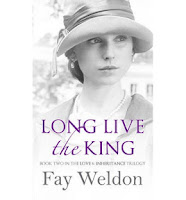
Now to the very different Long Live the King, book two in the Love and Inheritance Trilogy by Fey Weldon. We pick up soon after the first book Habits of the House left off. Lady Isobel is stressing about some extra invitations for the royal coronation. The four tickets they have already will naturally go to herself, her husband Lord Robert, their son Arthur and his wife Minnie. The three spare tickets are a real head ache, as Isobel doesn’t want her headstrong daughter Rosina to put off the whole event with her intelligent talk and strong opinions. Nor does she want her husband’s lowborn solicitor Eric Baum and his wife Naomi to get the tickets. In a moment of irritation with her husband, she sends the tickets to her husband’s alienated brother, a strict clergyman with no taste for lavish, vain affairs.
On the brother’s side, he not surprisingly asks his wife to throw away these heinous invitations. Their blooming daughter Adela is left to wonder at these relatives of hers she’s never met, but who always sends her Christmas gifts her father denies her to keep. When a fire kills the priest and his wife, Adela is suddenly left alone in this world, and by chance, a bishop and his wife takes her in. Due to his hatred for his brother, Lord Robert refuses to take her in, and because Adela might be a princess, Lady Isobel prefers not to push the issue. She has enough higher ladies to contend with when she goes to court, let alone in her own home.
Meanwhile, Adela’s old servant Ivy and her boyfriend George are planning their future. George is determined that they can make a good life through mysticism, which is all the rage in these days. However, they still need to find the perfect actress to really convince an audience. Adela’s ethereal beauty makes her perfect for the job. Adela on her side has been worn down into accepting a proposal by a Buddhist visionary Australian who she finds quite repulsive, while still fantasising about George who happened to save her from the fire that killed her parents, so she is quite likely to welcome this new opportunity. And seeing as none of the Dilbernes have seen fit to invite her to join their family, Adela jumps at the chance.
In the middle of all the drama, Isobel finds herself once again jealous of her husband, while Minnie adapts to her new position. Still a spinster, Rosina has pretty much resigned herself to her fate, but faith seems to smile at her this time around.
Although still sharp, I find that Weldon is a bit easier on her characters this time around. In Habits of the House Weldon quite openly mocked her characters, whereas here she sympathises a bit more. It’s still funny though, and the vices of the different people are really illuminated in an entertaining way, while we still get the interesting historical backdrop to the plot. I look forward to more elegant plotting from Weldon in the final installation of this trilogy.
So, two amazing but different books that I thoroughly enjoyed. If only there were more hours in the day, so that I had more time to read!
Tuesday, 4 June 2013
The Shining Girls tv rights sold!
To read more, look here.
Friday, 31 May 2013
Here and Now: Letters: 2008-2011 by Paul Auster and J. M. Coetzee
I finally had a chance to read Here and Now by two authors I greatly admire: Paul Auster and J. M. Coetzee. A google search shows me that critics aren't crazy about the work, but I think ones enjoyment of it comes out of what one is expecting. For me personally it was a way of getting a closer look at the people behind the books I've read and loved. The letters are spread over three years, and dip into serious philosophical discourses of different topics interspersed with personal anecdotes and exchanges. For me, it greatly humanized Coetzee, whose reputation of being closed off and distanced is often criticized. Auster strikes me as a very funny and thoughtful man. And to be a total modern dork, I have to say that their "bromance" is very touching at times.
What I love about this exchange of letters is the pairing of two authors who at once have so much in common, and yet are so different. This also comes across clearly in their letters. Auster on the one hand, who even mentions at some point that he keeps on talking about himself, but only as a "anybody", and Coetzee on the other who barely brings up really personal accounts. We learn that the authors meet on a few occasions between letters, but what they've talked about in person is never brought up. I would have loved to be a fly on the wall in one of their (and Auster's wife author Siri Hustvedt) meetings. Maybe that would make a good movie?
Some of my favourite quotes from the book:
- "Needless to say, I have spent my whole life exploring and meditating on my own name, and my great hope is to be reborn as an American Indian. Paul: Latin for small, little. Auster: Latin for South Wind. South Wind: an old American euphemism for a rectal toot. I therefore shall return to this world bearing the proud and altogether appropriate name of Little Fart" (Auster, p. 83-84).
- "I don't get much pleasure out of consuming novels.../ I must say that I get impatient with fiction that doesn't try something that hasn't been tried before, preferably with the medium itself" (Coetzee, p. 165).
One quite playful - the other serious. They reflect the range of discourse between the authors, as they move easily between heavy philosophical ideas to fun and banal musings. It might not work for the critics, but it works for me. If I were still in Uni, I would have loved using these letters as the starting point for a "compare and contrast" of the novels by Auster and Coetzee. Some of the topics they discuss shine light upon their very different approaches to fiction. Characterization, inspiration, the space in/of the novel, their relationships to critics, interviewers and readers, is all discussed. It might make me think differently about their fiction in the future.
As a great admirer of Siri Hustvedt's writing, it was also nice to see the pride Auster takes in her expressed in his letters to Coetzee. Siri's presence is felt throughout the exchange, not only through her one note to Coetzee, but through her constantly being invoked by the two authors.
I wouldn't mind continuing to read their letters. If they were actually emailing each other, I would ask to be added as a CC, but unfortunately the letters are faxed and mailed in the old-school way. Alas.
Now I wish I had a pen pal I could write (or fax) real letters to. Coetzee? Auster? Any of you need one more pen pal? Or maybe I should try Siri.
Oh, and on a side note. Turns out J. M. Coetzee is on his first visit to Norway attending a literature festival. Since I am in his birth country, I could naturally not attend, but my excellent former lecturer went and got me a signed copy of Childhood of Jesus. Could a girl ask for more? And what better way to start the weekend?
Friday, 24 May 2013
Redemption by Jussi Adler-Olsen | Scandinavian noir
One of the most exciting "new" voices of Scandinavian crime fiction is definitely the Danish Jussi Adler-Olsen. A publisher by profession, he knows what is demanded of really good crime literature, and he delivers the goods. For me, Adler-Olsen does more than merely follow the genre conventions. He is a magnificent storyteller and he really takes us into the heart of evil. A couple of years ago I read Mercy, book 1 in the "Department Q" series, which was deliciously dark and creepy. In his latest installment, Redemption (Book 3 in the series), we get to see yet another glimpse of true evil. I couldn't get to the end fast enough.
Two brothers are held captive in a boathouse on the Danish coast. One of them manages to write a message in a bottle, and throw the bottle into the ocean. Years later the message resurfaces, and it becomes cold case detective Carl Morck's job to try to decipher the almost obliterated message written in blood. Even though they can only make out a few of the words, there is no doubt in Carl's mind that this is dead serious.
In another part of the country, Mia is waiting for her husband to come home. His work is secret, so she spends most of her time alone with their toddler son. But lately Mia is starting to question the man she married. His controlling nature gives rise to suspicions that maybe he isn't quite what he pretends to be. Mia's decision to investigate for herself turns out to have fatal consequences.
And in the sect the Mother Church, a family with five kids find themselves the object of attention from a potential new member. The man is caring and enigmatic - a great role model for the children and a possible new friend for the parents. All of them remain ignorant as to his real intentions as he circles ever closer to the children.
As the man with countless names, faces and identities pounce on his next victims, only Carl and his team, Assad from Syria and Rose and her sister Yrsa have any chance of tracing him with only the message in the bottle as their starting point. Soon many lives hang in the balance, and time is running out.
What is so interesting about Adler-Olsen's books, is that the past and deep grudges play a great part. We follow not only the investigator and the victims, but also the murderer himself. The dark secrets of his past are rolled up one by one, even as our protagonists remain clueless.
Dark as the book might be, it has comic moments, especially in Assad's broken Danish (or English in this version) and the general office drama. The personal lives of Carl and his assistants are used to add to the suspense, but isn't really a driving force in the novel. A lot of the unresolved personal issues will stay there - to be engaged with again in the next book in the series.
The plotting is masterly done, and it gets to the point where nobody in the novel is in control of events, be it the murderer, the victims or the police. All the events of the novel come to a head towards the end, and as the reader you just have to plunge ahead to find out how in the world this is going to pan out.
Adler-Olsen had me going from the first page to the last. As crime goes, this is the right amount of noir for me. Reviews always say "Move aside Stieg Larsson (or some other crime fiction behemoth), XXX has entered the stage" (or something to that effect). I don't need to say that about Jussi Adler-Olsen. He's in a division of his own (Division Q, that is, hehe).
Wednesday, 22 May 2013
The Accidental Apprentice by Vikas Swarup
I absolutely loved Vikas Swarup's two former novels, Q&A (better known as Slumdog Millionaire) and Six Suspects (still waiting for the movie version!) so I was really excited to read his new novel The Accidental Apprentice. Similar to Q&A Swarup is inspired by TV culture in his new book, but this time it's the idea of "the Apprentice" which drives a lot of the plot.
Sapna Sinha sells electronics for a living, and is the main breadwinner in what remains of her family after her father and younger sister tragically passed away. When she is accosted by a business tycoon at the temple one day, Sapna's life changes drastically. Vinay Mohan Acharya has an offer Sapna simply cannot refuse. He wants her to take over as CEO of his company when he retires. All she has to do, is pass seven tests. These will determine whether she has what it takes to be Acharya's successor. The exact nature of the tests remain secret until she either has passed or failed them. Easy, huh?
Well, the tests pretty much begin the moment Acharya makes her the offer. From this point, Sapna's life is no longer really in her own hands, other than how she chooses to deal with the (emergency) situations that keep happening around her. At the same time, Sapna is forced to revisit her past and deal with the loss of her sister and father once more, whilst simultaneously continue to be a rock for her mother and still living other sister.
What I love about Swarup's novels is that they shine a light on a lot of the social problems in India, without being sentimental or milking the social pornography. Sapna is thrown into situations where she has to face among other things child labour, black market organ sale, forced marriage, corruption, rape and general violence. Swarup balances these serious topics with a light tone and a sense of humour.
Much as I enjoyed the novel, there was one drawback for me. I had trouble really believing in Sapna, the main character. As a character, she seemed to be too many different things at once. Sensitive and scared, but the next minute bold and fearless. It just didn't seem to quite fit for me. Of Swarup's three novels, this is probably my least favourite one, but it did grow on me more and more as I read. It's still a good and exciting read (two of my friends are busy with it at the moment and loving it).
My greatest anticipation when reading a Swarup novel is that he always has a twist at the end. In The Accidental Apprentice he certainly delivers the goods. I really tried to guess what the twist would be, and I thought I had it kinda figured out, but once more he completely outsmarted me, and I didn't see it coming from a mile away. Swarup - 3, Sigrid - 0. Next time Swarup, next time!
Subscribe to:
Posts (Atom)


