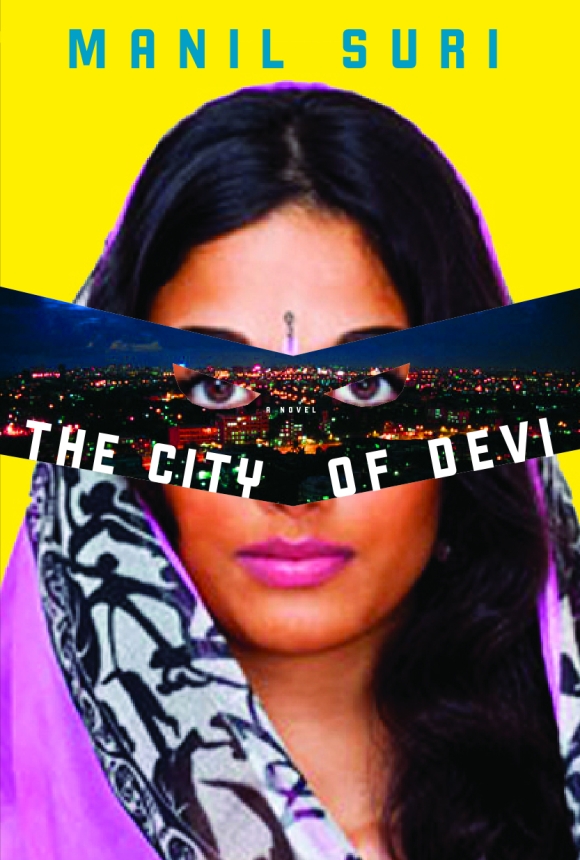
I didn't know what I was getting myself into when I started reading The City of Devi by Manil Suri. I love Indian literature, and the apocalyptic theme intrigued me, so I simply had to throw myself into it. The novel turned out to be nothing like what I imagined, and I'm kind of glad. It's refreshing to get some new perspectives, and Suri certainly conveys some interesting ideas!
Sarita's world is falling apart. Bombs have struck her city of Mumbai, all communication channels are cut off, rumours claim that terror has struck world-wide and that Pakistan will drop the atom bomb over Mumbai this week. Worst of all, in the middle of all this, her husband Karun is missing. We follow Sarita as she navigates the new warzone in her search for her husband. Muslims and Hindus are at each other's throats, and manage to find time between the bombings to brutally murder each other. But in the midst of all this, Sarita's mind is full of memories. Her and Karun's courtship, their marriage, and the importance of a pomegranate.
Enter Ijaz, a Muslim Sarita saves from certain death, who claims to want to pay her back by seeing her safely to her husband. Unsure if she can trust this smooth stranger who always has a new story for everything, it quickly becomes clear that they need each other to safely pass through areas that are either Hindu or Muslim. But Ijaz has secrets of his own, which ties him together to Sarita and Karun. As they start closing in on Karun's trail, it becomes clear that Ijaz has his own agenda. But will they even find Karun before the bomb is supposed to go off?
Sarita and Karun are navigating a landscape of religious fanaticism. After the Bollywood hit movie Superdevi, Mumbai has become the city of Devi. Our heroes start hearing rumours that Devi is here, and will protect her city against any attack. Fate leads them straight to the so-called Devi's doorstep, where they get up-close and personal with the young "goddess". Will the moody and whimsical Devi-ma be able to protect them, or will she be the cause of their demise?
The plot of the novel keeps thickening, and is constantly moving forward. We move between Sarita and Ijaz as narrators, and they in their turn move between the present, and their memories of the past. This works really well to create suspence and to let us see more sides to the story.
I can totally see this as a bollywood movie. The colours, the action, the grandness, the secrets, the identity crises. A major theme is the novel is identity. We never get to see Karun's perspective, but we get a strong sense of him as a troubled individual floating without an anchor. Sarita tries to be his anchor, but Karun sees the triangle as the perfect balance, and that is what is missing for him to be whole. He keeps returning to his father's notion that the divine triangle consists of Vishnu, Shiva and Devi, instead of the traditional assumption that Brahma was the third wheel. Similarly, this is the third book in a trilogy, the first two being The Death of Vishnu and The Age of Shiva.
Suri explores a number of conflicts in the novel. The clashes between hindus and muslims, between gays and straights, but perhaps most importantly the inner conflict of a person who is totally lost. Is it possible to find healing in a world that is at war?
I find that some of my beliefs have been challenged in reading this book. I question the devotedness of Sarita, and Ijaz, I am annoyed with Karun's lack of a backbone. But I was also taken for a joy ride. There are some really funny passages, and I was completely absorbed in the story, both of the present and the past. And even though Ijaz could be a completely selfish a**hole, he had some redeeming qualities.
The City of Devi is only available in 2013, so in the meantime you can read the other two novels. The Death of Vishnu was even nominated for the Booker, so well worth a go. Next time I'm in the mood for Indian I'll check it out;)
Thursday, 22 November 2012
Wednesday, 14 November 2012
The Murder of Norman Ware by Rosamund Kendal
Rosamund Kendal is a delightful South African author whose previous bestselling novels The Karma Suture and The Angina Monologues were great hospital chicklits. With her latest novel, Kendal makes the move into crime fiction. The Murder of Norman Ware is a fun and enjoyable crime book, with a strong tone of Desperate Housewives. So if you get a kick out of the narrating voice in Desperate Housewives, Kendal's novel will be right up your alley.
The residents of the luxurious San La Mer eco-estate outside Durban wake up to shocking news. Advocate Norman Ware is found mutilated and murdered in the men's bathroom. Judging from the missing body parts, he was tortured before being dealt a deadly blow to the head. How could such a thing happen in a secure estate?
Kendal introduces us to a large range of characters, each representing extremities of South African lives, and each playing some sort of part that lead up to the murder. From the Sangoma who trades in muti, to the corrupt businessman, from the bored housewife to the cheating husband. They all have interesting and highly South African stories to tell, and in this seemingly idyllic place, no one is innocent.
The Murder of Norman Ware is a joy to read. It's a novel that doesn't take itself too seriously, but it still offers pungent social critique. It's got loads of black humour, and if you're looking for an escape read, The Murder of Norman Ware is just the ticket.
The residents of the luxurious San La Mer eco-estate outside Durban wake up to shocking news. Advocate Norman Ware is found mutilated and murdered in the men's bathroom. Judging from the missing body parts, he was tortured before being dealt a deadly blow to the head. How could such a thing happen in a secure estate?
Kendal introduces us to a large range of characters, each representing extremities of South African lives, and each playing some sort of part that lead up to the murder. From the Sangoma who trades in muti, to the corrupt businessman, from the bored housewife to the cheating husband. They all have interesting and highly South African stories to tell, and in this seemingly idyllic place, no one is innocent.
The Murder of Norman Ware is a joy to read. It's a novel that doesn't take itself too seriously, but it still offers pungent social critique. It's got loads of black humour, and if you're looking for an escape read, The Murder of Norman Ware is just the ticket.
Tuesday, 13 November 2012
The Hunger Games Trilogy by Suzanne Collins | *crushing*
Oh how happy I am that my friend insisted I read the first book in the Hunger Games Trilogy even though I was persistent that I didn't need to read it since I'd seen the movie. I loved it!! And in quick succession I had to read the other two books as well. My conclusion? I want more!! And I can't wait for the rest of the movies to come out. According to IMDB there's a whole year to wait for Catching Fire and another two years for Mockingjay. It's much too long, and I've got serious withdrawal symptoms from Katniss and Peeta... *sigh* I just love it when I fall in love with books.
My second happiness came from realizing that I actually really enjoyed reading a so-called "Young Adult" series. I guess it's the fantasy element that pulled me in. "Adult" books seldom have the same magic as children's books, but I enjoy the magic. However, I still think I'll have a hard time finding a book that will fill the gap after Hunger Games. Anyone got any good suggestions? Love is essential.
Now to say a few things about the books. I thought all three books were brilliant. They're such accessible reads, the sentences flow beautifully and Collins' style is on the money. I loved how the plot kept thickening and how we were as much in the dark about things as Katniss. Katniss and the other characters keep changing and developing throughout everything that befalls them. And Katniss is a piece of work on her own... My only problem with the books is that Mockingjay simply was a little too short. I only wanted another two pages where everything could come together properly, but I am sure that was an editorial decision, and not entirely Collins' fault. I understand that "Young Adult" readers might only cope with a certain amount of pages, but I'm only asking for two more pages..!
Oh, and I really felt the story through music. Maria Mena's "I'm on Your Side" seemed like a perfect match to the books... If I could make one of those edits with clips from the movie to this song I'd totally do that.
Oh, and Beth Ditto's "Good Night Good Morning" also perfectly fits the theme of cameras, identity and total confusion...
My second happiness came from realizing that I actually really enjoyed reading a so-called "Young Adult" series. I guess it's the fantasy element that pulled me in. "Adult" books seldom have the same magic as children's books, but I enjoy the magic. However, I still think I'll have a hard time finding a book that will fill the gap after Hunger Games. Anyone got any good suggestions? Love is essential.
Now to say a few things about the books. I thought all three books were brilliant. They're such accessible reads, the sentences flow beautifully and Collins' style is on the money. I loved how the plot kept thickening and how we were as much in the dark about things as Katniss. Katniss and the other characters keep changing and developing throughout everything that befalls them. And Katniss is a piece of work on her own... My only problem with the books is that Mockingjay simply was a little too short. I only wanted another two pages where everything could come together properly, but I am sure that was an editorial decision, and not entirely Collins' fault. I understand that "Young Adult" readers might only cope with a certain amount of pages, but I'm only asking for two more pages..!
Oh, and I really felt the story through music. Maria Mena's "I'm on Your Side" seemed like a perfect match to the books... If I could make one of those edits with clips from the movie to this song I'd totally do that.
Each confession I make
Translates to you as an insult.
We must rid ourselves of this habit.
I once heard you say you'll
never love anyone more.
Then why am I still fighting you?
And it's never felt like this, before.
No, we've never fought like this, before.
But you, should, know,
That I am on your side,
I am on your side.
Although it may seem useless.
I am on your side.
Your hands are bearing,
worn down to the bone.
But you're still holding on me.
So I tighten my grip,
By god, I won't let you slip.
But can you breathe this way?
Translates to you as an insult.
We must rid ourselves of this habit.
I once heard you say you'll
never love anyone more.
Then why am I still fighting you?
And it's never felt like this, before.
No, we've never fought like this, before.
But you, should, know,
That I am on your side,
I am on your side.
Although it may seem useless.
I am on your side.
Your hands are bearing,
worn down to the bone.
But you're still holding on me.
So I tighten my grip,
By god, I won't let you slip.
But can you breathe this way?
And it's never felt like this, before.
No, we've never fought like this, before.
And I am on your side,
I am on your side.
Although it may seem useless.
I am on your side.
I am on your side.
Love was never this frail or so
good when it's good.
No, it's never felt like this, before.
And I am on your side,
I am on your side.
Although it may seem useless.
I am on your side.
I am on your side.
I am on your side.
No, we've never fought like this, before.
And I am on your side,
I am on your side.
Although it may seem useless.
I am on your side.
I am on your side.
Love was never this frail or so
good when it's good.
No, it's never felt like this, before.
And I am on your side,
I am on your side.
Although it may seem useless.
I am on your side.
I am on your side.
I am on your side.
Oh, and Beth Ditto's "Good Night Good Morning" also perfectly fits the theme of cameras, identity and total confusion...
Are you listening very carefully
Close your eyes and come with me
To go where the evening comes undone
Late at night in the city streets
I feel the need to see the streets
I go where you'll always find someone yeah
Is it good night, is it good morning
Is this real life, are you performing
You're like a vision I can't control
We're in a movie I'm playing a role
I can be by myself sometimes
But I won't be by myself tonight
The sun comes out and suddenly
Something's happening inside of me
I wanna now where the silence has come from
Is it good night, is it good morning
Is this real life, are you performing
You're like a vision I can't control
We're in a movie I'm playing a role
I can be by myself sometimes
But I won't be by myself tonight
I can be by myself sometimes
But I won't be by myself tonight
Close your eyes and come with me
To go where the evening comes undone
Late at night in the city streets
I feel the need to see the streets
I go where you'll always find someone yeah
Is it good night, is it good morning
Is this real life, are you performing
You're like a vision I can't control
We're in a movie I'm playing a role
I can be by myself sometimes
But I won't be by myself tonight
The sun comes out and suddenly
Something's happening inside of me
I wanna now where the silence has come from
Is it good night, is it good morning
Is this real life, are you performing
You're like a vision I can't control
We're in a movie I'm playing a role
I can be by myself sometimes
But I won't be by myself tonight
I can be by myself sometimes
But I won't be by myself tonight
So yes, I am properly crushing on these books. I am proudly "Team Peeta". The sad thing about finishing a book is that the initial awe cannot be relived. My comfort now is the upcoming movies which will hopefully be a great source for more of the Hunger Games magic.
Monday, 12 November 2012
Winter of the World by Ken Follett | The Great Story(teller)
I have been a proper slow-poke this last month. Reading Ken Follett's amazing new novel Winter of the World took me a long time, but truth be told, I'm glad it did. It deserved not to be raced through, but savoured rather.
I read Fall of Giants last year, and had high expectations to the second installment in the Century trilogy, but Follett didn't let me down. Follett is one of the greatest storytellers alive, and once more he perfectly weaves together factual history with fictional characters who come to life in a stunning way. Follett has managed to put together a daunting amount of material in a highly accessible way.
I was happy to see that we hadn't seen the last of my beloved characters from Fall of Giants. But 20 years have passed and the main characters are the children of the main characters of Fall of Giants. The characters are spread over England, France, Germany, Russia and USA, so we are presented with a very full picture of the war from all sides. Since all of the characters are very reflected, regardless of political view, we get insight into a variety of situations, ranging from the Nazi supporter to the Russian spy, from the British soldier to the American politician. All are fully fleshed characters who are forced to change in the course of the war.
In Ken Follett's stories, there is always a very strong dichotomy between good and evil. There are always evil characters involved who are making life difficult for our heroes. But you can trust that good always defeats evil in the end in his writing. Now that I have read a few of Follett's books, I question if Follett perhaps makes those distinctions a little too easy at times. As "classic" stories go, we do expect and want good to win in the end, and of course in the big picture of the war it did, but I still feel that Follett can be a little harder on his "babies" and not always conveniently killing off the bad-guys towards the end. Real life isn't like that (yes, I know, this isn't real life, and people do want a happy ending).
Winter of the World is a history lesson with soul. It brings to life the horrible years of war, the terror, the hunger, the desperation, the blood, but it does it with heart. Once again I genuinely came to care for the characters who was at the heart of it all. And once I finished the book I just wished my grandparents were still alive so that I could pick up the phone and get an answer to all the questions this book triggered in me. I am hungry for more.
I am so excited now about the third installment! Follett keeps blowing me away, and I want him to just keep writing, keep the good stuff coming..! Winter of the World fully satisfied my cravings for a good story and left me with a lot to chew on. Come Christmas, I will pick my parents' brains for what blanks they can fill in, but unfortunately my grandparents' stories were never written down.
I read Fall of Giants last year, and had high expectations to the second installment in the Century trilogy, but Follett didn't let me down. Follett is one of the greatest storytellers alive, and once more he perfectly weaves together factual history with fictional characters who come to life in a stunning way. Follett has managed to put together a daunting amount of material in a highly accessible way.
I was happy to see that we hadn't seen the last of my beloved characters from Fall of Giants. But 20 years have passed and the main characters are the children of the main characters of Fall of Giants. The characters are spread over England, France, Germany, Russia and USA, so we are presented with a very full picture of the war from all sides. Since all of the characters are very reflected, regardless of political view, we get insight into a variety of situations, ranging from the Nazi supporter to the Russian spy, from the British soldier to the American politician. All are fully fleshed characters who are forced to change in the course of the war.
In Ken Follett's stories, there is always a very strong dichotomy between good and evil. There are always evil characters involved who are making life difficult for our heroes. But you can trust that good always defeats evil in the end in his writing. Now that I have read a few of Follett's books, I question if Follett perhaps makes those distinctions a little too easy at times. As "classic" stories go, we do expect and want good to win in the end, and of course in the big picture of the war it did, but I still feel that Follett can be a little harder on his "babies" and not always conveniently killing off the bad-guys towards the end. Real life isn't like that (yes, I know, this isn't real life, and people do want a happy ending).
Winter of the World is a history lesson with soul. It brings to life the horrible years of war, the terror, the hunger, the desperation, the blood, but it does it with heart. Once again I genuinely came to care for the characters who was at the heart of it all. And once I finished the book I just wished my grandparents were still alive so that I could pick up the phone and get an answer to all the questions this book triggered in me. I am hungry for more.
I am so excited now about the third installment! Follett keeps blowing me away, and I want him to just keep writing, keep the good stuff coming..! Winter of the World fully satisfied my cravings for a good story and left me with a lot to chew on. Come Christmas, I will pick my parents' brains for what blanks they can fill in, but unfortunately my grandparents' stories were never written down.
Wednesday, 3 October 2012
City of Dragons by Robin Hobb | Coming Home
Reading Robin Hobb is like coming home. It's familiar, warming and things are the same, but different. City of Dragons, the third installment of The Rain Wilds Chronicles ties together this series with the previous trilogies The Farseer and The Liveship Traders.
The dragons and their keepers have finally reached Kelsingra, the mythical city of the Elderlings. But because most of the dragons cannot fly, they are stuck on the other side of the river. Only Heeby can so far fly to Kelsingra at will, and she is happy to bring her keeper Rapskal, as well as the "expert" on Elderlings, Alise.
Through their explorations of the city, readers of The Farseer will rediscover Kelsingra, and some of the mysteries Fitz never got to the bottom of will be shed light on. Will the city drown the keepers in memories? And what will happen to the city once Leftrin reaches Cassarick and the rest of the world learns about the existence of the mythical city?
Malta, Reyn and Selden are also prominent characters in this book. They didn't play a big part in the first two books of the series, but here we finally meet them properly again and learn their fates after the events of The Liveship Traders. Malta is pregnant with what she hopes will be her and Reyn's first living child. Malta's younger brother Selden is in a very different predicament. Taken captive in Chalced as "the dragon man" he has to endure cruelties untold.
On top of this, the Chalcedeans are upping their hunt for dragons and dragon parts. Tintaglia learns a painful lesson in an unexpected encounter with arrows. And on his return to Cassarick, Leftrin learns that more people than expected are involved in the Chalcedean plot. The Chalcedeans are desperate, and will stop at nothing to get what they want. Once the idea strikes them that Elderling parts might serve the same purpose, things get very dangerous for our Elderling heroes.
I love being back in Robin Hobb's world, and I cannot get enough of this universe. I get to relive the initial awe of Kelsingra from The Farseer, but now the pieces are coming together. The two first books of this series was possibly a bit slow, but City of Dragons really picks up the pace and widens the scope of the story. We are no longer solely focusing on the slow trek upriver, we have reached the destination and get to see what else is happening in the world. I'm just bummed I now have to wait 6 months to read the final book, Blood of Dragons. Is it too much to ask, dear sweet Robin Hobb, that Fitz or the Fool/Amber make an appearance in the final book? All the other knots are being tied up, but I have to admit, every now and then I stop and wonder what Fitz is doing now. The end of Fool's Quest left room for a last adventure, but perhaps that is another novel (or trilogy)... *fingers crossed*
It should be clear by now that I really loved this book. Robin Hobb delivers reading experiences like no other. It's when I read her novels that I remember why I love fantasy fiction. I have to say, it seems that she's become more brutal in this book, and I like that. She's not at George R R Martin-level, but it's still nice.
Robin Hobb, please keep writing. You practically took my fantasy-virginity, and I will always love you for that and return to you again and again.
The dragons and their keepers have finally reached Kelsingra, the mythical city of the Elderlings. But because most of the dragons cannot fly, they are stuck on the other side of the river. Only Heeby can so far fly to Kelsingra at will, and she is happy to bring her keeper Rapskal, as well as the "expert" on Elderlings, Alise.
Through their explorations of the city, readers of The Farseer will rediscover Kelsingra, and some of the mysteries Fitz never got to the bottom of will be shed light on. Will the city drown the keepers in memories? And what will happen to the city once Leftrin reaches Cassarick and the rest of the world learns about the existence of the mythical city?
Malta, Reyn and Selden are also prominent characters in this book. They didn't play a big part in the first two books of the series, but here we finally meet them properly again and learn their fates after the events of The Liveship Traders. Malta is pregnant with what she hopes will be her and Reyn's first living child. Malta's younger brother Selden is in a very different predicament. Taken captive in Chalced as "the dragon man" he has to endure cruelties untold.
On top of this, the Chalcedeans are upping their hunt for dragons and dragon parts. Tintaglia learns a painful lesson in an unexpected encounter with arrows. And on his return to Cassarick, Leftrin learns that more people than expected are involved in the Chalcedean plot. The Chalcedeans are desperate, and will stop at nothing to get what they want. Once the idea strikes them that Elderling parts might serve the same purpose, things get very dangerous for our Elderling heroes.
I love being back in Robin Hobb's world, and I cannot get enough of this universe. I get to relive the initial awe of Kelsingra from The Farseer, but now the pieces are coming together. The two first books of this series was possibly a bit slow, but City of Dragons really picks up the pace and widens the scope of the story. We are no longer solely focusing on the slow trek upriver, we have reached the destination and get to see what else is happening in the world. I'm just bummed I now have to wait 6 months to read the final book, Blood of Dragons. Is it too much to ask, dear sweet Robin Hobb, that Fitz or the Fool/Amber make an appearance in the final book? All the other knots are being tied up, but I have to admit, every now and then I stop and wonder what Fitz is doing now. The end of Fool's Quest left room for a last adventure, but perhaps that is another novel (or trilogy)... *fingers crossed*
It should be clear by now that I really loved this book. Robin Hobb delivers reading experiences like no other. It's when I read her novels that I remember why I love fantasy fiction. I have to say, it seems that she's become more brutal in this book, and I like that. She's not at George R R Martin-level, but it's still nice.
Robin Hobb, please keep writing. You practically took my fantasy-virginity, and I will always love you for that and return to you again and again.
Thursday, 20 September 2012
Tigers in Red Weather by Liza Klaussmann
My boss recommended this book to me the other day, and since I found the cover so awesome, I decided to give it a shot. I literally devoured it. Liza Klaussmann's debut novel is an impressive piece of narrative technique and elegance. A closely knit plot with characters you can't decide if you love, loathe, or simply fear, this is a novel which will keep you guessing right until the end (and it's not even a crime fiction book, technically).
The book kicks off in 1945 when the cousins Nick and Helena's ways are parted with the end of the war. Nick is to be reunited with her husband Hughes who fought in the war, and Helena is off to Hollywood to marry her new husband Avery. But the honeymoon period is short-lived. Nick finds herself whiling away the days in the choking Florida heat, waiting for her husband who she now longer feels she knows. And Helena quickly wakes up to a reality where her new husband's attentions are focused on his "life project". In a year, both woman are pregnant. And as the years pass by, the cousins reunite in New England at Tiger House. But one summer the children Daisy and Ed witness something that will change all their lives forever.
I love the structure of the book. We start off with Nick as the focalizer, and we get her perspective from her life as a bored housewife who aches for her husband's attention and gets a kick out of flaunting her tiny bathing suit in front of her neighbours. One day an incident occurs, and Hughes finally decides they should move back to New England.
After Nick, we have skipped forwards in time to 1959 when Nick's daughter Daisy is 12. Daisy and Nick, Helena and Ed are all at Tiger House for the summer. Daisy is obsessing with her tennis, but she's also falling in love for the first time with Tyler Pierce. Though Daisy finds her cousin Ed strange, she's easily persuaded when he asks her to come spying with him, and through their eavesdropping, we get suggestions as to what is going on under the surface in the relationships between the adults. The tension is thick in the air, and we quickly realize that all is not how it should be. This turns out to be the summer that will change everything for the kids, and the consequences will be fatal.
We skip forwards in time to 1967 and another summer at Tiger House. The focalizer is Helena, and through her flashbacks we learn about her early days of marriage and how she discovered she was stuck with her Hollywood husband who devouted all his time and money to his "project". When she fell pregnant with Ed, Helena started hoping for a better life. But Ed turned out to be a lot like his father, always conducting "research" and not really getting along with other kids. The only one who seemed to like Ed was Daisy, who is now engaged to Tyler Pierce. But Helena is anything but happy for them, and we learn that she's nurtured a growing resentment towards her cousin Nick. The tension in the novel keeps growing and we know that a disaster is about to happen.
The next focalizer is Hughes. His story skips between the war and until the present time of the story. We meet a man who feels that he's made a mess of things but is unable to make it right. His own mistakes cripple him from confronting others', and despite having dark suspicions about certain people, he is unable to do anything concrete about it. But Hughes really tries. Through Hughes' perspective some light is shed on certain occurrences, and we're starting to form a fuller picture of everything that's going on under the surface in Tiger House.
Fittingly, the last focalizer is the ever silent and unnerving Ed. Ironically, in his segment Ed is unable to speak. But he is still able to reveal what is going on behind his blank facial expressions. The build-up is perfect, and until the very last pages we are holding our breaths for fear of what will happen. The tension is so high-strung you can feel it in the air of the house. And Ed's distanced way of seeing things keeps us on the edge until the very last.
Klaussmann has written an almost perfect novel. "Almost" because I want her to keep doing it. I love the retro nostalgia of the setting, the nod to The Great Gatsby, the skips in focalizer which keeps the tension, the perfectly timed revelations of past incidences, the fullness and complexities of the characters, which seem to add dimensions with each person's point of view... It is simply put one of those really good novels that I'll recommend to ANYONE.
Finally I want to make a comment about the title, which I did not know came from the Wallace Steven's poem "Disillusionment of Ten O'Clock". The title is taken directly from the poem, and Klaussmann was inspired by the poem to write the book. The poem juxtaposes the ordinary vs. the extraordinary, and lack of imagination vs. a vivid imagination. I find this resonates well within the novel in several ways, and one could easily write an article exploring this. I would just like to say that Nick constantly strives for the extraordinary within her life as a "housewife". She wants to break free of her "place", but that does not always turn out for the best. I also feel that the poem suggests that everything is not always how it seems on the surface, and this is very true for Tiger House.
Read it and see the tigers prowling around the house at night, preying on each other.
The book kicks off in 1945 when the cousins Nick and Helena's ways are parted with the end of the war. Nick is to be reunited with her husband Hughes who fought in the war, and Helena is off to Hollywood to marry her new husband Avery. But the honeymoon period is short-lived. Nick finds herself whiling away the days in the choking Florida heat, waiting for her husband who she now longer feels she knows. And Helena quickly wakes up to a reality where her new husband's attentions are focused on his "life project". In a year, both woman are pregnant. And as the years pass by, the cousins reunite in New England at Tiger House. But one summer the children Daisy and Ed witness something that will change all their lives forever.
I love the structure of the book. We start off with Nick as the focalizer, and we get her perspective from her life as a bored housewife who aches for her husband's attention and gets a kick out of flaunting her tiny bathing suit in front of her neighbours. One day an incident occurs, and Hughes finally decides they should move back to New England.
After Nick, we have skipped forwards in time to 1959 when Nick's daughter Daisy is 12. Daisy and Nick, Helena and Ed are all at Tiger House for the summer. Daisy is obsessing with her tennis, but she's also falling in love for the first time with Tyler Pierce. Though Daisy finds her cousin Ed strange, she's easily persuaded when he asks her to come spying with him, and through their eavesdropping, we get suggestions as to what is going on under the surface in the relationships between the adults. The tension is thick in the air, and we quickly realize that all is not how it should be. This turns out to be the summer that will change everything for the kids, and the consequences will be fatal.
We skip forwards in time to 1967 and another summer at Tiger House. The focalizer is Helena, and through her flashbacks we learn about her early days of marriage and how she discovered she was stuck with her Hollywood husband who devouted all his time and money to his "project". When she fell pregnant with Ed, Helena started hoping for a better life. But Ed turned out to be a lot like his father, always conducting "research" and not really getting along with other kids. The only one who seemed to like Ed was Daisy, who is now engaged to Tyler Pierce. But Helena is anything but happy for them, and we learn that she's nurtured a growing resentment towards her cousin Nick. The tension in the novel keeps growing and we know that a disaster is about to happen.
The next focalizer is Hughes. His story skips between the war and until the present time of the story. We meet a man who feels that he's made a mess of things but is unable to make it right. His own mistakes cripple him from confronting others', and despite having dark suspicions about certain people, he is unable to do anything concrete about it. But Hughes really tries. Through Hughes' perspective some light is shed on certain occurrences, and we're starting to form a fuller picture of everything that's going on under the surface in Tiger House.
Fittingly, the last focalizer is the ever silent and unnerving Ed. Ironically, in his segment Ed is unable to speak. But he is still able to reveal what is going on behind his blank facial expressions. The build-up is perfect, and until the very last pages we are holding our breaths for fear of what will happen. The tension is so high-strung you can feel it in the air of the house. And Ed's distanced way of seeing things keeps us on the edge until the very last.
Klaussmann has written an almost perfect novel. "Almost" because I want her to keep doing it. I love the retro nostalgia of the setting, the nod to The Great Gatsby, the skips in focalizer which keeps the tension, the perfectly timed revelations of past incidences, the fullness and complexities of the characters, which seem to add dimensions with each person's point of view... It is simply put one of those really good novels that I'll recommend to ANYONE.
Finally I want to make a comment about the title, which I did not know came from the Wallace Steven's poem "Disillusionment of Ten O'Clock". The title is taken directly from the poem, and Klaussmann was inspired by the poem to write the book. The poem juxtaposes the ordinary vs. the extraordinary, and lack of imagination vs. a vivid imagination. I find this resonates well within the novel in several ways, and one could easily write an article exploring this. I would just like to say that Nick constantly strives for the extraordinary within her life as a "housewife". She wants to break free of her "place", but that does not always turn out for the best. I also feel that the poem suggests that everything is not always how it seems on the surface, and this is very true for Tiger House.
Read it and see the tigers prowling around the house at night, preying on each other.
Philida by Andre Brink | Long Walk to Freedom
Andre Brink says that his latest Man Booker-nominated novel, Philida has been the hardest one to date. Perhaps because in writing it, Brink had to delve into the past, truthfully as well as fictionally. Philida is inspired by true events that happened on a 1800s farm in the Cape area. At this point in this, this farm belonged to relatives of Brink's ancestors.
Philida opens with the slave woman Philida walking all the way to Stellenboch to file a complaint against her master's son, a Francois Brink. Four kids have come from their union, but the main problem is that Francois promised Philida her freedom in exchange for her body. Now that Francois is being pushed into a favourable marriage by his parents, Philida's prospects are suddenly bleak. But come hell or high water, Philida refuses to see her dream of freedom shattered.
Set around the same time as In the Heart of the Country by J M Coetzee, I can't help but make some connections between the two stories. Both novels focus on a female isolated character. But the racial, and in other words, social differences also makes their choices different. Ironically, whereas Magda in In the Heart of the Country wants to escape her isolation and desperation through words and fiction, Philida can settle for nothing less than freedom. She wants to have the freedom to say "this I will do, and this I will not do". She wants to exert herself to proclaim her own freedom. Magda sees herself trapped within a male hierarchy, but can only escape it through imagined patricide. Philida defies her "place" and confronts her suppressors head on.
There is a lot of walking in the book. I cannot help but draw lines to the metaphorical 'long walk to freedom. Philida walks to Stellenboch and back, to Cape Town, and finally, her last trek to the Gariep, which is a kind of promised land for slaves. In her journey of discovery, Philida comes to find herself, the muslim faith, and she realizes how she can be free. Philida is becoming a real pilgrim.
An added dimension in this story is that we do not only see Philida's viewpoint, but also Francois' and his father's. Even though our sympathies remain with Philida, we are reminded that each story has more than one side, and that slavery makes slaves of us all - including the 'baas'.
Philida is a beautifully written novel which I enjoyed immensely. Philida truly comes to life and is an intriguing and complex character. I haven't really read any books addressing slavery in SA before, so this was educational for me. I'm not sure I think it deserves a Man Booker prize, but it definitely deserves a large readership.
Philida opens with the slave woman Philida walking all the way to Stellenboch to file a complaint against her master's son, a Francois Brink. Four kids have come from their union, but the main problem is that Francois promised Philida her freedom in exchange for her body. Now that Francois is being pushed into a favourable marriage by his parents, Philida's prospects are suddenly bleak. But come hell or high water, Philida refuses to see her dream of freedom shattered.
Set around the same time as In the Heart of the Country by J M Coetzee, I can't help but make some connections between the two stories. Both novels focus on a female isolated character. But the racial, and in other words, social differences also makes their choices different. Ironically, whereas Magda in In the Heart of the Country wants to escape her isolation and desperation through words and fiction, Philida can settle for nothing less than freedom. She wants to have the freedom to say "this I will do, and this I will not do". She wants to exert herself to proclaim her own freedom. Magda sees herself trapped within a male hierarchy, but can only escape it through imagined patricide. Philida defies her "place" and confronts her suppressors head on.
There is a lot of walking in the book. I cannot help but draw lines to the metaphorical 'long walk to freedom. Philida walks to Stellenboch and back, to Cape Town, and finally, her last trek to the Gariep, which is a kind of promised land for slaves. In her journey of discovery, Philida comes to find herself, the muslim faith, and she realizes how she can be free. Philida is becoming a real pilgrim.
An added dimension in this story is that we do not only see Philida's viewpoint, but also Francois' and his father's. Even though our sympathies remain with Philida, we are reminded that each story has more than one side, and that slavery makes slaves of us all - including the 'baas'.
Philida is a beautifully written novel which I enjoyed immensely. Philida truly comes to life and is an intriguing and complex character. I haven't really read any books addressing slavery in SA before, so this was educational for me. I'm not sure I think it deserves a Man Booker prize, but it definitely deserves a large readership.
Subscribe to:
Posts (Atom)


