Pages

Monday, 11 July 2011

Julius Winsome by Gerard Donovan | Shakespearean words and violence

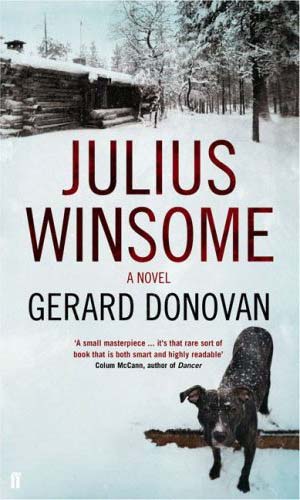
Julius Winsome has just been translated into Norwegian, and got the title Vinter i Maine. When it arrived at my bookshop I was immediately drawn in by the cover, and when we got a reading copy from the publisher, I knew I had to read it.

The story evolves around Julius Winsome, a loner who lives in the middle of a desolate hunting area in Maine. The novel begins as his four-legged companion, Hobbes, is shot, and Julius has to bury his only friend. Julius is in many ways a strange man, but his grief is authentic and I as the reader really emphatised with him.

The setting of this novel really underlines the themes. The isolation of Julius' cottage and his isolation as a person go hand in hand. We learn that Julius' mother died giving birth to him, and that Julius lived with his father in this cottage until his father passed away. He has literally grown up walled in by books, as book shelves go from one wall to the next. Julius was brought up rehearsing Shakespearean words, and sometimes hearing tales of war from his father and grandfather. Ironically, the Winsome men are men of few words (although they're vocabulary is larger than most people's). This again creates a gap between Julius and other people. The world makes more sense to him when he can describe it with Shakespearean words. However, he points out that when he uses the Shakespearean words, he might as well be barking, because people don't understand him. At one point he has a girlfriend, but she abandons him just as suddenly as she showed up at his door.

The use of Shakespeare's words is also connected to the violence of the story. Shakespeare's works are full of violence and treachery, and since Julius knows little of other people apart from malevolence and betrayal, he finds comfort in hiding behind the shield of words. This works both literally, as his house is a stronghold of books, and his haven, as well as figuratively, in that he uses the words to perhaps feel distinct and above others.

A strong theme in this novel is nature, and how we live with it. For Julius, the forest is part of him, almost. He is safe in nature, he can read it and communicate with it. Julius knows a lot about hunting, camouflage, weapons, yet he seems to have a strong distaste for hunters. It is as if the animals of the forest somehow are kin to him, and the hunters are overstepping this bond. After his dog Hobbes is shot, Julius is determined to find who shot him, and balance things out. An eye for an eye, so to speak. It is clear that Julius' solitude, which has survived the loss of mother, father, lover, cannot survive the loss of Hobbes. Ironically, Hobbes is Julius' last symbolic connection to other people, as it was his ex girlfriend who suggested he get a dog. Once Hobbes is dead, that bond is severed, and Julius' isolation is complete. The reaction is a revenge plot.

This novel is truly beautifully written. Julius is authentic, and as a narrator he is quiet but telling. The story is tender, despite its violence. Julius bares his soul to us, showing us his hurt and solitude without asking for pity. Despite his isolation, he is a reflected man; he knows what he is doing. And his acts of violence are, if not justified, then at least reasonable to himself. I also find him quite kick-ass, and would love to see a movie where the revenge hero inflicts a deadly wound on someone, only to quote Shakespeare to them. In his quiet way, this novel is Julius' demand to be seen and recognised by the world. I for one came to care deeply for him... And I was truly sad when the novel ended.

Read it.

Wednesday, 6 July 2011

Rush Home Road by Lori Lansen

Rush Home Road by Lori Lansen was recently translated into Norwegian by Juritzen Forlag.

I saw the book on the shelf, read the blurb, and decided that I had to read it. I was in for a pleasurable and moving journey through Addy Shadd's life.

Addy Shadd is in her 70s and suddenly finds herself responsible for 6-year old Sharla who has been abandoned by her mother. Her initial misgivings aside, Addy quickly comes to realise that she can love Sharla like a mother, and the two become central in each other's lives. Addy, because Sharla needs a mother figure who loves her and who will actually raise her right, and Sharla, because Addy needs a child in her life to come to terms with all the disappointments and sorrows she's faced.

A central conflict in the story is how Addy is literally forced to abandon her home town Rusholme, leaving everything she loves behind, to start alone elsewhere. Addy's character builds strenght as she goes along, but there is always this pull to rush home. However, the wounds connected to Rusholme run too deep, and Addy resists this pull.

The kindness of strangers is a strong motif in this book. Addy herself is an example of this through taking Sharla in, but her own experiences of being helped by strangers might be the reason for her openness. Addy leaves Rusholme without money or food, but her kind heart and honest soul makes people help her and take to her. Addy finds friends she comes to love, and she manages to start a new life.

I found it interesting how important food is in the novel. For Sharla, it is central because at her mother's place she was often barely fed, and when fed, fed badly. For Addy, on the other hand, food is attached to identity, place and memory. Food is what connects her to her family. The apple snow her mother taught her to make as a young girl, is her father's favourite, and Addy knows how to make it just right. Addy in turn teaches Sharla how to make it, to heal a wound inside herself. Further, Addy's cooking skills have helped her make friends and to be useful when she's had to rely on others.

The story evolves around how Sharla and Addy interact and change through each other's influence, as well as the story of Addy's life. At times the story is deeply moving, even shockingly so, but it also has a light and funny tone. The end of the book, in which Addy finally rushes home to Rusholme becomes a symbolic home-coming for the both of them, and is beautifully, beautifully written. This is a novel that really comes full circle and that lets the reader down gently at the end.

Simply a must-read. Have your Kleenex ready.

Jane Eyre

Jane Eyre by Charlotte Brontë was my first classical read. And to this day, it remains my favourite. We read an excerpt in school, and watched the 1996 movie version, which I enjoyed. Later I borrowed the book from a phd friend of my aunts, and true love was found. Since then I've read the book a few times, as well as all the other Brontë titles.

In 2006 BBC made an excellent Jane Eyre tv series. They really managed to capture the passion, emotions and underlying tensions the book holds. I loved their use of colour, especially for Bertha and Blanche. The chemistry between Mr Rochester and Jane is simply outstanding and they really make the story come to life. As a whole, they make Jane Eyre more accessible to a more modern audience. oh, and Toby Stephens is my number one Mr Rochester to date. *blush*

A few days ago I went to see the latest Jane Eyre movie (2011). I had read some excellent reviews on it, and I was really looking forward to seeing it. I must admit, I was a little disappointed. Now, obviously, it is unfair for a movie of 2 hours to compete with a tv series of 4 hours. Naturally the movie has to convey in a much briefer period of time the book's essence. However, I cannot help but wonder at some of the choices that were made.

Bertha is all but invisible in the film. There are hardly any trace of her, and the famous "veil-ripping" scene doesn't happen here. I miss the tension built up in the series and I thought there would be more of her here.

A character that got a lot more room than I thought necessary, was St. John. And in fact, the focus on Jane's life after Thornfield, when she is taken in by St. John and his sisters have a lot more focus than I feel is warranted for such a short movie. I'd rather have more Jane and Mr Rochester than Moor House.

I actually liked Michael Fassbender as Mr Rochester (although he comes nowhere near Toby Stephens), but something was missing in the chemistry between him and Jane. Mia Wasikowska makes a reliable Jane, and I really liked that she's young, but I miss some warmth and emotion from her.

One touch I really liked, however, is that they managed to include the lightning struck tree after the proposal scene. Nice touch!

All in all not a bad movie, but I guess I was hoping for something that was more influenced by how well done the tv series was. With classics, there'll be another remake in about 10 years, however, so I can look forward to a life time of Jane Eyre movies. And in the meantime I'll enjoy the tv series one more time on DVD.

Below: a treat. One of my fave scenes from the BBC version. Just showing a new side to Jane.

Saturday, 2 July 2011

Pretty!

I LOVE the new series from Cappelen Damm, "Historiske Drama Romaner" and their covers. Beautiful, evocative and appealling.

You shouldn't judge a book by it's cover, but a nice cover doesn't harm sales!

Friday, 24 June 2011

Smaken av Eplekjerner av Katharina Hagena

As I can't find any inclination that this originally German novel has been translated into English, I'll write my thoughts about it in Norwegian.

Smaken av Eplekjerner er, som tittelen foreslår, en bok som passer perfekt å lese om sommeren. Dette er en roman hvor setting, eller sted driver handlingen fremover.

Iris arver bestemorens hus, og tilbringer noen dager på eiendommen for å avgjøre hvorvidt hun skal beholde det. Ettersom Iris beveger seg gjennom ikke bare selve huset, men også eiendommen som er full av frukt, urter og planter, vekkes gamle og vonde minner til liv igjen. Stedet som Iris lekte som barn skjuler nemlig mange mørke hemmeligheter som Iris må konfrontere.

Noe av det jeg likte best med denne romanen er sanseligheten den vekker hos meg som leser. Du kan virkelig kjenne lukten av frukter og blomster, og du får en svært sterk opplevelse av stedet handlingen skjer.

Som litteraturviter likte jeg også svært godt Iris' drøfting av det å glemme vs. det å huske, og hvordan disse "samarbeider". For eksempel trekker hun frem hvordan en tekst både bidrar til å huske og å glemme. Man skriver ned det man ønsker å huske av en historie, og dermed uteblir noe av det som egentlig var sannheten, man velger å glemme noe:

"Lese, det var det samme som å samle, og å samle var det samme som å oppbevare, og å oppbevare var det samme som å huske, og å huske var det samme som å ikke vite helt sikkert, og å ikke vite helt sikkert var det samme som å ha glemt, og å glemme var det samme som å falle, og disse fallene måtte ta slutt." (s. 18)

"I tillegg var det man skrev ned, noe man ikke behøvde merke seg, altså noe man trygt kunne glemme, for nå visste man jo hvor det sto, og dermed trådte det enda en gang i kraft, det som gjaldt for lesingen." (s. 19).

Gjennom sitt opphold i bestemorens hus, og i møte med mennesker som berører fortiden, tvinges Iris til å huske. Familiehistorien og de mange forbannelsene, eller fallene som Iris forteller oss har rammet kvinnene i denne familien kommer fram i lyset. Ulikt andre bøker jeg har lest som har samme "formel" (type Kate Morton), går ikke Iris spesielt dypt inn på de forskjellige hendelsene/spøkelsene fra fortiden. Hun drar dem fram, og så ferdig med den saken. Personlig tror jeg ikke romanen hadde tatt skade av å ha mer kjøtt på bena, men som lett sommerlektyre funker det fint likevel.

Ellers har romanen en tidvis lekende og morsom dialog, samt enkelte komiske scener som gjør at boken kanskje ikke er så ambisiøs, men heller ønsker å vekke ettertanke, en sanselig tilstedeværelse, og en god følelse hos leseren. Og det klarer den absolutt!

Smaken av Eplekjerner er er en vakker fortelling som passer perfekt på deilige sommerdager (eller for å frembringe dem i ditt sinns øye). Dette er visstnok Hagenas debutroman, og jeg håper virkelig at hun skriver litt lengre neste gang!

Thursday, 23 June 2011

Love Virtually by Daniel Glattauer

Some books you just know that you have to read. Working in a bookshop gives me access lots and lots of great books, and I'd noticed that a few people would pick up the Norwegian translation of Love Virtually, despite the paperback cover being a bit more anonymous than most these days. The other day we got the second book by Glattauer, Every Seventh Wave, which is the follow-up to Love Virtually. Curious at last, I picked up Love Virtually (the Norwegian copy), opened it up and read the first couple of pages. The verdict was clear: I have to read this book!

I read the book in the course of an evening. It takes you on quite an emotional ride. At one point I was completely in love with the book. Then it broke my heart a few times. And then it left me empty. I'm glad I'll start reading Every Seventh Wave today, because I have to know what'll happen.

I'm not a fan of typical sappy love stories. I avoid romance novels (and films alike). The english title of this book, Love Virtually, sounds like the type of book I prefer not to read. But this is nothing like a sappy love story. As a love story, it is very different from anything I've read before.

An email sent to the wrong person triggers a correspondence between Emmi and Leo. Email after email pass between them, and the increasing interest in each other literally skips off the pages (or screen, in their case?). The characters are funny and vivid, their dialogue is amusing and intelligent, and of course Leo's research on emotional communication through emails gives it all an added dimension.

Leo points out that since they do not know each other physically, they have to read each other between the lines, and on the lines. The same goes for us as readers. We know little more about these characters than they are willing to expose to each other. And as Leo again points out, they have this dance of revealing as little about themselves as they can, so as to stay mystical and interesting to each other. So we are left as completely in the dark as they themselves are.

Eventually, however, personal things are revealed, with, at times, upsetting consequences. One of them is married with children, whereas the other keeps trying to reignite a destructive relationship. Simultaneously, Emmi and Leo's relationship evolves into something less innocent than merely email friends. The action is driven towards a need to meet and finally know each other physically, but this meeting keeps being postponed. As frustrating for the reader as for Emmi and Leo. As we get closer and closer to the climax of this final personal encounter, the story takes an unexpected turn, which left me feeling quite empty. As my boss, who's also read the book put it: "I was so angry at the end. This is a crap book. Why did it have to end this way?" This was before she knew there was a second book.

I really enjoyed this book. It is definately relevant in our time and age. The language of the novel is beautiful, the characters are funny and likeable, and the story is built up really well, with increasing suspense and frustration for the characters and readers simultaneously. At the same time it is also quite an upsetting read. Issues of fidelity is questioned, and Leo asks when is it cheating? When you exchange emails? When you listen to someone's voice on your receiver? When you dream of kissing someone? When you actually have sex with someone? As the reader I can't quite tell when the line has been crossed, and when they pass the point of no return.

I can't wait to read The Seventh Wave now and tell you my final verdict. I just hope I'm not left hanging the way I was at the end of Love Virtually.

Wednesday, 22 June 2011