Pages

Monday, 21 January 2013

The Childhood of Jesus by J M Coetzee | Another masterful novel by Coetzee

Gosh did I feel happy when my boss so generously allowed me to throw myself into the new J M Coetzee before her! It's due for release in March this year, and I feel kind of special to be one of the first in the world (out of prolly a few thousand other preview readers!) to have the privilege of reading The Childhood of Jesus. I literally inhaled the book which will definitely intrigue literature students worldwide in the next century. It would not surprise me in the least if Coetzee with this novel would go on to take his third Booker Prize. 

With The Childhood of Jesus Coetzee goes back to the almost sci-fi setting of Waiting for the Barbarians. Time and place is not defined. All we know is that we are in a (real? imaginary?) Spanish-speaking place called Novilla (which means "young bull"), that our protagonists have come across the ocean in search of a new life. They've had to leave their old lives behind. Memories, names, old family ties, and even language seems lost. We also learn that there is no return to whence you came. Those who come to this place must first learn Spanish, and then build a new life for themselves.

We follow the old man Simon (turns out he's estimated to be 45) and his "charge"/"godson" David, who is around 5. We learn that they arrived on a boat and that they stayed in the camp Belstar where they learned Spanish for 6 weeks. They have just arrived in Novilla, where Simon wants to search for David's mother. Without having ever met her, and with David remembering not a thing about her, Simon is still convinced they will somehow recognise her on sight.

The people in Novilla are helpful, and they express a lot of "goodwill", but there seems to be something lacking. Simon laments that they have left all feelings of passion behind. A diet of mostly bread seems to bother none of the other citizens, but for Simon it is simply not enough. His appetites for a meaty diet and even for women, have not been "washed clean". He still craves human touch, and he takes up a passionless sexual relationship with one of the neighbouring women. With his views and his appetites, there is a strong sense that Simon does not quite fit in with his peers. Nonetheless, he has a job and colleagues who respect him, and it is clear that David looks up to him.

From the start, Simon is clear about his mission. Before the boat, he did not know David, and the details about the boat trip are very unclear. We learn that David had a letter that got lost on the boat, a letter that in some way is connected to his mother. There also seems to be suggested that there was some kind of accident on the boat, and that it is a miracle they are both still alive. At any rate, Simon's mission is to reunite David with his mother one way or the other. When they eventually do find the mother Ynes, she turns out to be quite set in her ways of raising David. For a while David is completely kept away from his old "godfather", and Ynes' mothering threatens to completely spoil the child. But in one respect both Ynes and Simon wholeheartedly agree: David is an exceptional child.

Ynes does not want to send David to school, so Simon attempts to teach him to read through a children's version of Don Quixote. Similar to the character of Don Quixote, David sees the imaginary as being the real. In many ways, David absorbs Don Quixote's characteristics as believing himself to be a hero with great powers, as wanting to save someone who doesn't wants to be saved, and in seeing the world differently to the majority. Throughout this, Simon patiently humours him, whilst simultaneously explaining that other people might see the world differently. Despite David's intelligence, he seems to have a resistance against learning to read and write, and against numbers. He writes gibberish claiming that it means something, and expresses a deep fear of falling between numbers. Simon can't be sure if David is wrong and everyone else is right, or if it's the other way around. Eventually David is sent to school, and this is when the cracks truly begin to show.

Coetzee seems to be paying homage to Cervantes and Don Quixote in this novel. David embodies the essence of Don Quixote in what is considered one of the first novels ever written. We're in a Spanish speaking country where the imagination seems to colour everything David sees. If I had ever actually read Don Quixote I am sure there would be a whole added reading to Coetzee's novel, but I will stick with the little I know.

Seeing as the book is called The Childhood of Jesus, I cannot escape making comment of David as Jesus. David is of course also the name of Jesus' ancestor, King David, who also slayed Goliath. A little man who defeated a giant. In David's case, perhaps a prediction that David will topple the philosophical beliefs that prevail in Novilla? He is a child who does not fit in. Similar to Jesus, his beliefs do not fit in with the accepted norm. David's ideas are radical, and he will easily contest the truths of anyone else, including his "parents" Simon and Ynes. At some point he claims to walk through barbed wire, but we later learn the "truth" that there is no barbed wire. Further, David is happy to spend his time with "sinners" such as Senor Daga who is clearly a bad apple.

To connect this to his "parents", we have Simon who is older, and admits to not being his biological father, similar to how Joseph was not Jesus' biological father. He still protects and loves David as if he was his own. His name can also be connected to Jesus' apostle, Simon Peter who perhaps is best know for having denied Jesus. Ynes is perhaps not David's biological mother, but Simon claims that he intuitively felt that she was David's "true" mother. She strikes Simon as being virginal, similar to the Virgin Mary. Ynes is also derived from the name Agnes, who was a virgin martyr.

There is a lot of philosophy in this novel. Simon gets a job carrying cargo onto boats. It is heavy work, and he questions his foreman and his colleagues why they simply do not use machines for this type of work. The men launch into a philosophical debate about being closer to the thing itself, etc... And despite being working men, they all know their philosophy. And whilst Simon is happy to philosophize, he does not enjoy the philosophy class his colleagues are taking. The chairness of a chair, and the tableness of a table is of no interest to him.

I was kind of hoping for some sort of explanation by the end of the novel. Where did they come from? And why? What really happened? Seeing as it is Coetzee, I should have known better. I am left with two theories. Something big has happened in the world, and this Spanish-speaking place, be it actually Spain, or perhaps South America, seems to be the promised land of whatever time we're in. We're in a brave new Ellis Island. However, in order to be part of (physically) building this new place, the people go through some sort of brainwashing, or rebirth, to leave their memories and their passions behind. For Simon, this is only partly successful. There is no return-trip however. Novilla has a university where the citizens are encouraged to take classes for free, to educate themselves. A lot of other things are free, but the price seems to be that once you've committed to this new world, there is no going back.

My other theory is that this is death. The people have no memory simply because in the afterlife, your past life doesn't matter anymore. You have been "washed clean". Passions are dead, because you are actually dead. Thus David is alone without his mother, Simon is alone, and none of the family units in the novel are made up of actual blood relations. Thus the "new life" Simon is always talking about, is an actual new life. There is no going back, but who knows, there might be another new life somewhere else - in the reincarnation sense. This would also explain the vagueness of the boat trip, and the accident which David and Simon somehow "survived". In some old beliefs and religions, you leave this life on a boat to the next life. In the afterlife, everyone is feeling goodwill, but nothing more. With the exception of Simon. To take this reading further, I can also theorize that perhaps David is a sort of saviour in this world. The other people are still clinging to the laws of the human world, whereas David can see that there are gaps between numbers that you can fall between, and that there is a different language with which to communicate. He is trying to aid them in letting go of human logic, and in the case of Simon and Ynes, he at least has their acceptance. Perhaps this is taking it a bit far, but it's fun to play with ideas anyway.

I really liked this book. Congratulations J M Coetzee on yet another masterpiece! In my opinion the best Coetzee since Disgrace and definitely worthy of a Booker prize, numerous articles, and PhD's and master thesis's. If you haven't read Coetzee before, you have until March to read Boyhood and Disgrace as a sort of preparation. However, The Childhood of Jesus has a power that is uniquely its own, and uniquely Coetzeean. Go find out for yourself. 


Wednesday, 5 December 2012

The Time Keeper by Mitch Albom | Interesting about time

I haven't read Mitch Albom before, who is probably most famous for Tuesdays with Morrie, so I didn't quite know what to expect from this novel. But I must admit that I somehow had formed the notion that I would be served something quite deep. In this regard I personally was disappointed. The beginning was simply too obvious, and I felt that Albom left little for the reader to conclude on her own. In addition, the style of the novel was very un-novelly. At times the narrator steps out of the story and says things like "consider the word 'time' ", and then goes on a quasi-philosophical explication of the concept. This is yet another example of how he makes it too obvious for me personally. That could also be Albom's style of writing, but unfortunately this type of writing doesn't appeal that strongly to me. I prefer the power of implication. That said, I eventually got interested in the story, if only to find out the fate of "father time" Dor.

In the book we meet three characters. Dor, who lived 6000 years ago and who in this novel is the embodiment of "father time". Dor's big flaw is that he invents the concepts and measurements of time, thus cursing mankind with a feeling of never having enough time, or of having too much time. When his wife lays dying of plague, Dor's attempt to stop time leads to his imprisonment by God in a cave where he has to listen to the voices of mankind begging for more -or less -time. 

The other two characters are contemporary people. Victor is dying from cancer and has decided to defeat death through cryonics, where his body will be frozen, to be revived in the future when his disease can be cured. He keeps his plans hidden from his wife Grace, and spends his every waking moment finalizing his plans for his next life.

Our last character is the teenager Sarah who is head-over-heels in love with Ethan. Being a loner, Ethan's attentions are even more worth, but it soon becomes clear that Ethan is not interested. When Ethan not only rejects Sarah, but takes it one step further and humiliates her, Sarah can see no other way out than for it all to stop.

God returns to set Dor free, but has one last task to give him. He must find Victor and Sarah, and he must understand why man's days are numbered. Thus after 6000 years, father time is set free into the world again.

Once more I have to say that Albom wasn't deep enough for me. Of the characters, I only really sympathize with Dor. Neither Victor or Sarah moved me, and I didn't feel that I got to know them well enough to understand their choices. Albom is merely scratching the surface. I feel as if Albom was more concerned about the form of his book, the way the stories of Sarah and Victor were construed as parallels, the way the concept of time was at the core of every scene, rather than getting to the deep-down psychology. Despite its flaws, though, Albom brought up some interesting points and made some fun historical connections which I enjoyed.

The Time Keeper is in no way a deep delve into the concept of time, but it definitely gets you thinking and philosophizing about time and your personal appreciation of the moment. It's a quick read, so I didn't lose too much time of my life reading it;) And Dor made it all worth it in the end.

Tuesday, 4 December 2012

Zoo Time by Howard Jacobson

Maybe I've just read too many metafictional novels or just wasn't in the mood for so-called "literary" fiction at the moment, but I had a hard time really getting into Howard Jacobson's Zoo Time. Jacobson is heralded as a funny writer, and I could see what was supposed to be funny, but it wasn't for me. Only when I was about 100 pages in did I start appreciating the book, but considering that the narrator Guy keeps lamenting that nobody reads anymore, I think that's fair.

The novel is very much a novel about writing. Guy Ableman is a semi-successful author who is currently going down along with the rest of the publishing industry. Female readers complain that he doesn't understand women, his publisher has just committed suicide, and it seems that the rest of the industry are all constantly constipated. Lacking inspiration, Guy turns to his real-life fantasy for material. He wants to write about having an affair with his mother-in-law Poppy, much to the despair of his agent, who feels that this material will appeal to noone. But when his wife Vanessa finally gets serious about her threats to write, things really start looking dark for our "hero".

The parallels are not lost on the reader. What Guy wishes to do in his novel, Jacobson essentially does in Zoo Time. While Guy is watching the book industry crumble, Jacobson is also commenting on a declining industry.

I have to admit that the more I read, the more I enjoyed the book. Guy isn't easy to sympathize with, but one can still enjoy the read. And the ending is just priceless. I kind of had the feeling that Guy pretty much deserved all the misfortunes that came his way, and this is turned around towards the end.

I didn't laugh as much as the "funny" on the book cover suggested I ought to, but then again, Guy does point out that having that branding on the cover of one's book is a guarantee to make people not find it funny. 

Thursday, 22 November 2012

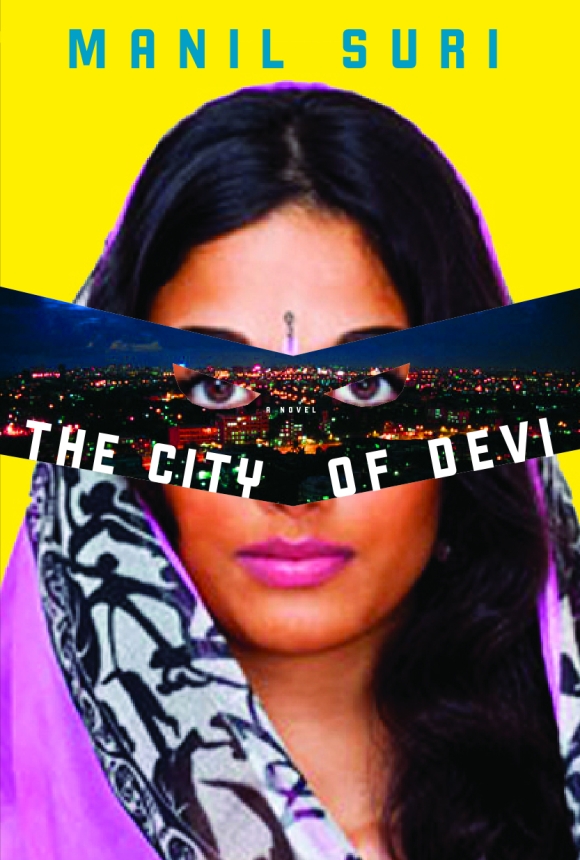
The City of Devi by Manil Suri | Apocalypse now

I didn't know what I was getting myself into when I started reading The City of Devi by Manil Suri. I love Indian literature, and the apocalyptic theme intrigued me, so I simply had to throw myself into it. The novel turned out to be nothing like what I imagined, and I'm kind of glad. It's refreshing to get some new perspectives, and Suri certainly conveys some interesting ideas!

Sarita's world is falling apart. Bombs have struck her city of Mumbai, all communication channels are cut off, rumours claim that terror has struck world-wide and that Pakistan will drop the atom bomb over Mumbai this week. Worst of all, in the middle of all this, her husband Karun is missing. We follow Sarita as she navigates the new warzone in her search for her husband. Muslims and Hindus are at each other's throats, and manage to find time between the bombings to brutally murder each other. But in the midst of all this, Sarita's mind is full of memories. Her and Karun's courtship, their marriage, and the importance of a pomegranate.

Enter Ijaz, a Muslim Sarita saves from certain death, who claims to want to pay her back by seeing her safely to her husband. Unsure if she can trust this smooth stranger who always has a new story for everything, it quickly becomes clear that they need each other to safely pass through areas that are either Hindu or Muslim. But Ijaz has secrets of his own, which ties him together to Sarita and Karun. As they start closing in on Karun's trail, it becomes clear that Ijaz has his own agenda. But will they even find Karun before the bomb is supposed to go off?

Sarita and Karun are navigating a landscape of religious fanaticism. After the Bollywood hit movie Superdevi, Mumbai has become the city of Devi. Our heroes start hearing rumours that Devi is here, and will protect her city against any attack. Fate leads them straight to the so-called Devi's doorstep, where they get up-close and personal with the young "goddess". Will the moody and whimsical Devi-ma be able to protect them, or will she be the cause of their demise?

The plot of the novel keeps thickening, and is constantly moving forward. We move between Sarita and Ijaz as narrators, and they in their turn move between the present, and their memories of the past. This works really well to create suspence and to let us see more sides to the story.

I can totally see this as a bollywood movie. The colours, the action, the grandness, the secrets, the identity crises. A major theme is the novel is identity. We never get to see Karun's perspective, but we get a strong sense of him as a troubled individual floating without an anchor. Sarita tries to be his anchor, but Karun sees the triangle as the perfect balance, and that is what is missing for him to be whole. He keeps returning to his father's notion that the divine triangle consists of Vishnu, Shiva and Devi, instead of the traditional assumption that Brahma was the third wheel. Similarly, this is the third book in a trilogy, the first two being The Death of Vishnu and The Age of Shiva.

Suri explores a number of conflicts in the novel. The clashes between hindus and muslims, between gays and straights, but perhaps most importantly the inner conflict of a person who is totally lost. Is it possible to find healing in a world that is at war?

I find that some of my beliefs have been challenged in reading this book. I question the devotedness of Sarita, and Ijaz, I am annoyed with Karun's lack of a backbone. But I was also taken for a joy ride. There are some really funny passages, and I was completely absorbed in the story, both of the present and the past. And even though Ijaz could be a completely selfish a**hole, he had some redeeming qualities.

The City of Devi is only available in 2013, so in the meantime you can read the other two novels. The Death of Vishnu was even nominated for the Booker, so well worth a go. Next time I'm in the mood for Indian I'll check it out;)

Wednesday, 14 November 2012

The Murder of Norman Ware by Rosamund Kendal

Rosamund Kendal is a delightful South African author whose previous bestselling novels The Karma Suture and The Angina Monologues were great hospital chicklits. With her latest novel, Kendal makes the move into crime fiction. The Murder of Norman Ware is a fun and enjoyable crime book, with a strong tone of Desperate Housewives. So if you get a kick out of the narrating voice in Desperate Housewives, Kendal's novel will be right up your alley.

The residents of the luxurious San La Mer eco-estate outside Durban wake up to shocking news. Advocate Norman Ware is found mutilated and murdered in the men's  bathroom. Judging from the missing body parts, he was tortured before being dealt a deadly blow to the head. How could such a thing happen in a secure estate?

Kendal introduces us to a large range of characters, each representing extremities of South African lives, and each playing some sort of part that lead up to the murder. From the Sangoma who trades in muti, to the corrupt businessman, from the bored housewife to the cheating husband. They all have interesting and highly South African stories to tell, and in this seemingly idyllic place, no one is innocent.

The Murder of Norman Ware is a joy to read. It's a novel that doesn't take itself too seriously, but it still offers pungent social critique. It's got loads of black humour, and if you're looking for an escape read, The Murder of Norman Ware is just the ticket. 

Tuesday, 13 November 2012

The Hunger Games Trilogy by Suzanne Collins | *crushing*

Oh how happy I am that my friend insisted I read the first book in the Hunger Games Trilogy even though I was persistent that I didn't need to read it since I'd seen the movie. I loved it!! And in quick succession I had to read the other two books as well. My conclusion? I want more!! And I can't wait for the rest of the movies to come out. According to IMDB there's a whole year to wait for Catching Fire and another two years for Mockingjay. It's much too long, and I've got serious withdrawal symptoms from Katniss and Peeta... *sigh* I just love it when I fall in love with books.

My second happiness came from realizing that I actually really enjoyed reading a so-called "Young Adult" series. I guess it's the fantasy element that pulled me in. "Adult" books seldom have the same magic as children's books, but I enjoy the magic. However, I still think I'll have a hard time finding a book that will fill the gap after Hunger Games. Anyone got any good suggestions? Love is essential.

Now to say a few things about the books. I thought all three books were brilliant. They're such accessible reads, the sentences flow beautifully and Collins' style is on the money. I loved how the plot kept thickening and how we were as much in the dark about things as Katniss. Katniss and the other characters keep changing and developing throughout everything that befalls them. And Katniss is a piece of work on her own... My only problem with the books is that Mockingjay simply was a little too short. I only wanted another two pages where everything could come together properly, but I am sure that was an editorial decision, and not entirely Collins' fault. I understand that "Young Adult" readers might only cope with a certain amount of pages, but I'm only asking for two more pages..!


Oh, and I really felt the story through music. Maria Mena's "I'm on Your Side" seemed like a perfect match to the books... If I could make one of those edits with clips from the movie to this song I'd totally do that.

Each confession I make
Translates to you as an insult.
We must rid ourselves of this habit.
I once heard you say you'll
never love anyone more.
Then why am I still fighting you?
And it's never felt like this, before.
No, we've never fought like this, before.
But you, should, know,

That I am on your side,
I am on your side.
Although it may seem useless.
I am on your side.

Your hands are bearing,
worn down to the bone.
But you're still holding on me.
So I tighten my grip,
By god, I won't let you slip.
But can you breathe this way?
And it's never felt like this, before.
No, we've never fought like this, before.

And I am on your side,
I am on your side.
Although it may seem useless.
I am on your side.
I am on your side.

Love was never this frail or so
good when it's good.
No, it's never felt like this, before.

And I am on your side,
I am on your side.
Although it may seem useless.
I am on your side.
I am on your side.
I am on your side.
 
Oh, and Beth Ditto's "Good Night Good Morning" also perfectly fits the theme of cameras, identity and total confusion...

Are you listening very carefully
Close your eyes and come with me
To go where the evening comes undone
Late at night in the city streets
I feel the need to see the streets
I go where you'll always find someone yeah

Is it good night, is it good morning
Is this real life, are you performing
You're like a vision I can't control
We're in a movie I'm playing a role

I can be by myself sometimes
But I won't be by myself tonight

The sun comes out and suddenly
Something's happening inside of me
I wanna now where the silence has come from

Is it good night, is it good morning
Is this real life, are you performing
You're like a vision I can't control
We're in a movie I'm playing a role

I can be by myself sometimes
But I won't be by myself tonight

I can be by myself sometimes
But I won't be by myself tonight

So yes, I am properly crushing on these books. I am proudly "Team Peeta". The sad thing about finishing a book is that the initial awe cannot be relived. My comfort now is the upcoming movies which will hopefully be a great source for more of the Hunger Games magic.

Monday, 12 November 2012

Winter of the World by Ken Follett | The Great Story(teller)

I have been a proper slow-poke this last month. Reading Ken Follett's amazing new novel Winter of the World took me a long time, but truth be told, I'm glad it did. It deserved not to be raced through, but savoured rather.

I read Fall of Giants last year, and had high expectations to the second installment in the Century trilogy, but Follett didn't let me down. Follett is one of the greatest storytellers alive, and once more he perfectly weaves together factual history with fictional characters who come to life in a stunning way. Follett has managed to put together a daunting amount of material in a highly accessible way.

I was happy to see that we hadn't seen the last of my beloved characters from Fall of Giants. But 20 years have passed and the main characters are the children of the main characters of Fall of Giants. The characters are spread over England, France, Germany, Russia and USA, so we are presented with a very full picture of the war from all sides. Since all of the characters are very reflected, regardless of political view, we get insight into a variety of situations, ranging from the Nazi supporter to the Russian spy, from the British soldier to the American politician. All are fully fleshed characters who are forced to change in the course of the war.

In Ken Follett's stories, there is always a very strong dichotomy between good and evil. There are always evil characters involved who are making life difficult for our heroes. But you can trust that good always defeats evil in the end in his writing. Now that I have read a few of Follett's books, I question if Follett perhaps makes those distinctions a little too easy at times. As "classic" stories go, we do expect and want good to win in the end, and of course in the big picture of the war it did, but I still feel that Follett can be a little harder on his "babies" and not always conveniently killing off the bad-guys towards the end. Real life isn't like that (yes, I know, this isn't real life, and people do want a happy ending).

Winter of the World is a history lesson with soul. It brings to life the horrible years of war, the terror, the hunger, the desperation, the blood, but it does it with heart. Once again I genuinely came to care for the characters who was at the heart of it all. And once I finished the book I just wished my grandparents were still alive so that I could pick up the phone and get an answer to all the questions this book triggered in me. I am hungry for more.

I am so excited now about the third installment! Follett keeps blowing me away, and I want him to just keep writing, keep the good stuff coming..! Winter of the World fully satisfied my cravings for a good story and left me with a lot to chew on. Come Christmas, I will pick my parents' brains for what blanks they can fill in, but unfortunately my grandparents' stories were never written down.